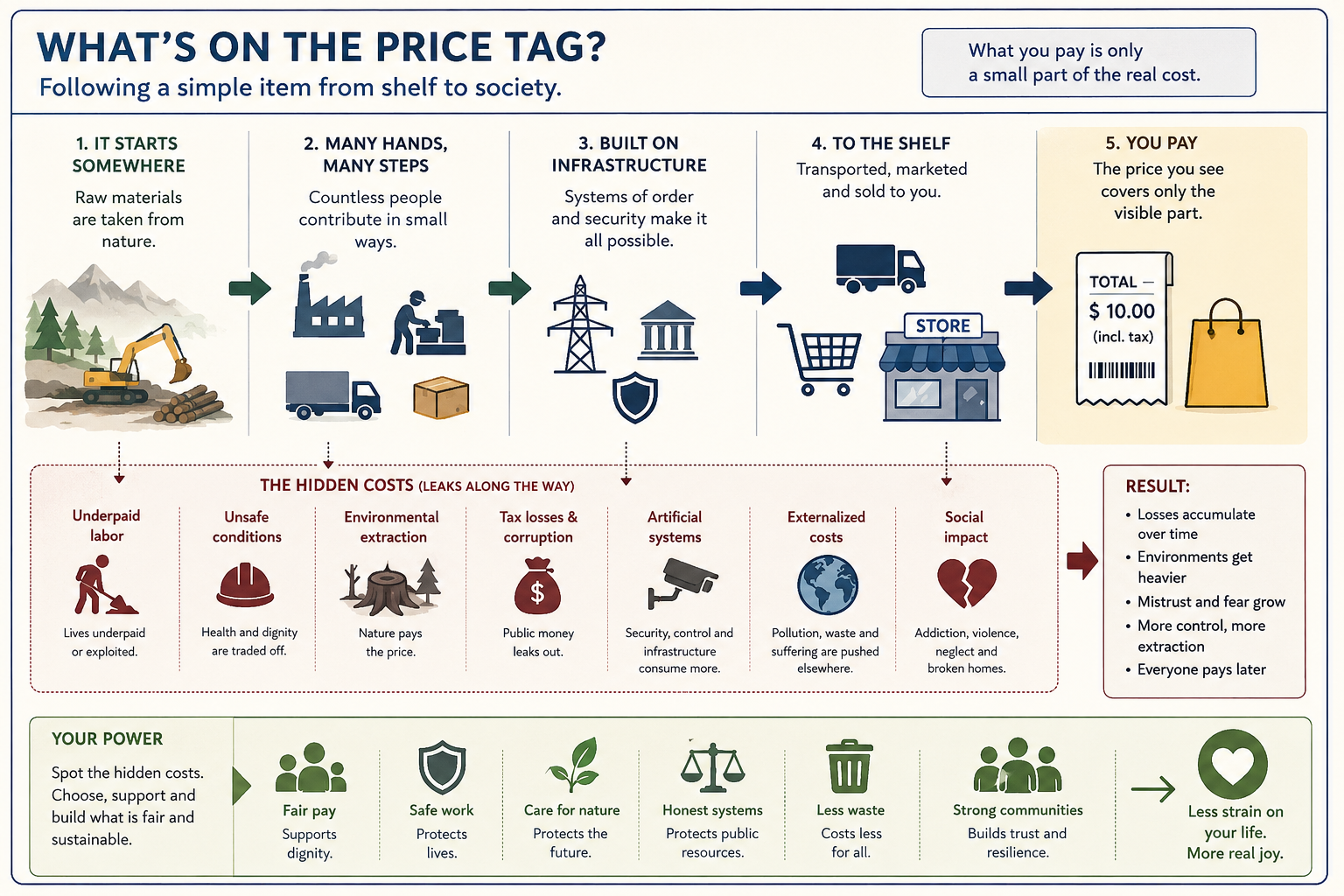
Imagine walking through the streets, looking at the prices of goods. Perhaps getting a snack, spotting the tax note on a receipt. It may be that the variety surprises you, or a particular style stands out. Learning to identify contexts that involve hidden costs is empowering.
A day spent in a city can tell a lot about a country.
Every day, goods are produced, transported, and bought. During this process, items pass through a multitude of transactional links, only to eventually be presented on the shelves of a store. Imagine the way minerals are sourced by a tree, through complex processes, and turned into something such as an acorn. A squirrel might pick it up, carrying it a distance to its nest. Eventually it eats it, and at some point the squirrel itself might get eaten. It could be by a big bird, catering to the needs of the ecosystem.
Unlike the natural processes, the compilation of a shelf item depends on heavy infrastructure. Countless tiny fragments of countless sustained man-hours are consumed in making the functions and pathways of society possible. It’s much like eating a meal; often, it’s comprised of many parts, seldom only one.
Each of these, in turn, relies on a few fundamental elements, like order and security. It may rely on “details” being hidden, capital-drains nesting beneath these cost-heavy systems. You might envision a building in which temperature-adjustments leak at windows, doors, ventilation, or cracks in the wall. Like the amount of water in a bottle decreasing, which can occur in a variety of ways.
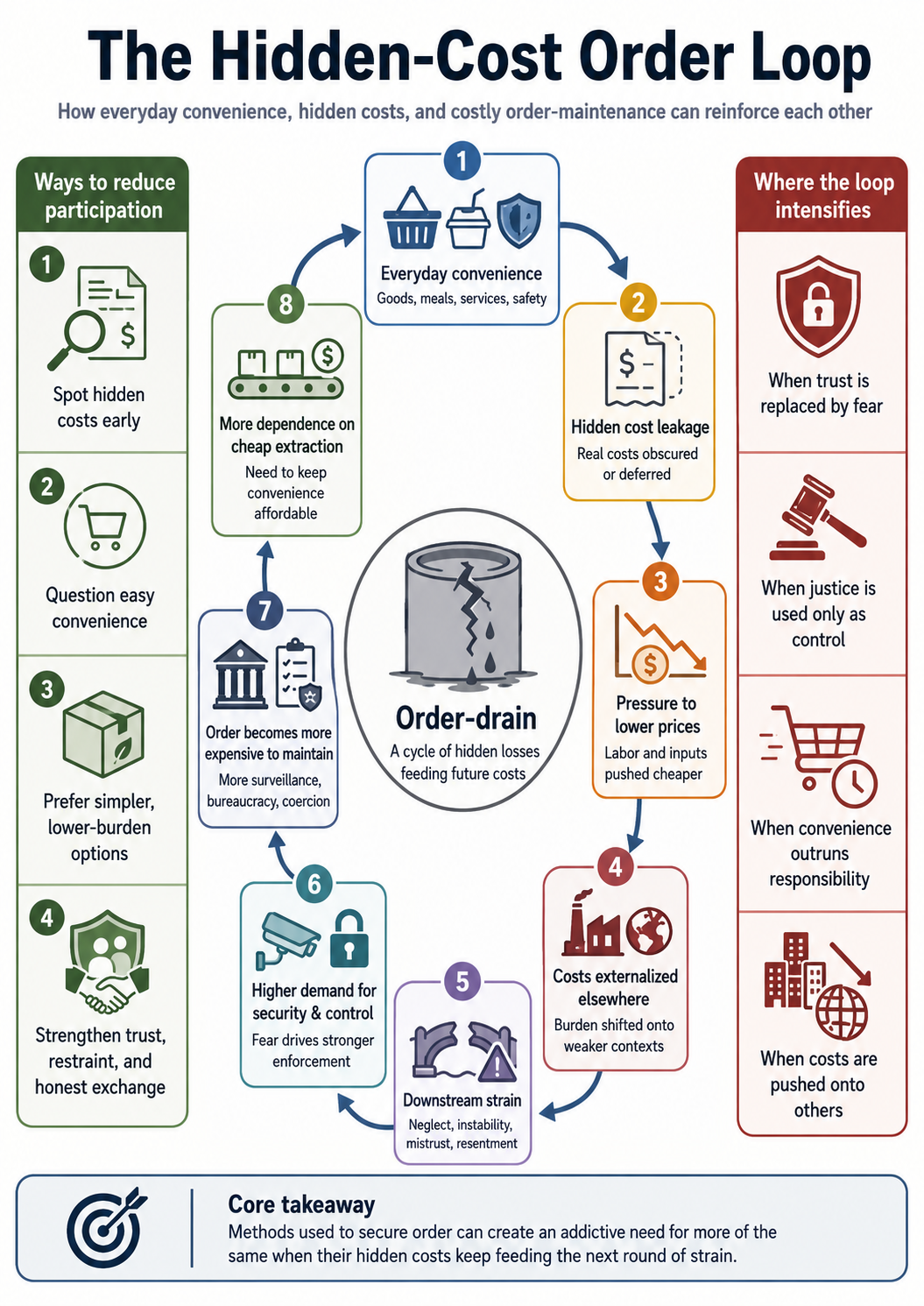
This consumes tax money. It is like a water-tap, sourced by sustained exports, internal transactions, and the like. It continues artificial environmental conditions, which are consumed for such as lowering the costs to labor. The labor, at some cost, turns into tax money.
Labor demands capital to cover expenditures like food, shelter, gear, and co-processing; capital is oft accessed at a lower cost by pressuring the prices lower. This gets achieved oft by leaving lives underpaid, exploited, and kept in less-than-optimal working conditions.
In the past, losses were frequently pushed unto the poor locals. Think of a squirrel that has to walk a long distance to get water or acorns. Today, the trend is more focused on externalizing costs unto foreign environments. The squirrel has an exoskeleton and neural implants, while some of its furry friends get creepy things done to them in labs for that to be possible.
Down-the-line, some lives suffer at addictions, as negativity accumulates through impact, weird twists, and unresolved malice. Some grow up with neglectful parents, others are left without religion, some get beaten and some develop undesirable habits. The displaced costs demand later.
Up-the-line, these losses can increase the loss to every passing hour. Environments get heavier, and demand more value-creation to balance out the loss. Hatred grows, vengeance-needs build, and the mistrust in judicial systems worsens, creating a heavy demand for security, control, and dominance. Pressure that builds, intensifying the demand to extract resources as cheaply as possible.
In other words, there’s a simple way to reduce strain on personal resources: spotting these complicity traps before getting caught up in looped hidden costs.
Joy
Of course, it’s neat to be able to enjoy a good meal. It might not even cost that much, but when the costs are pushed elsewhere, it gets harder to enjoy over time. Ever had a simple meal after a tough fast? It beats a Michelin-rated restaurant with ease.
Being able to safely go to a religious place, too, builds piety. Praying often is great. Although faith built on a shaky foundation may get tested. Keeping it simple may build up greater spiritual wealth, while it may take longer.
Enjoying sex comes with no shortage of benefits. It might feel good too. However, if it’s outside the boundaries of a defined relation, lacking spiritual solvency, or exploitative, it may leave an empty feeling, unceasingly craving more.
And it’s about building up while it’s easy. Not all costs get externalized; some lives are left starving, others deprived of religious wisdom, and yet others struggle at being denied a decent partnering-life. Sometimes, people get denied freedom in the name of law and justice, sustaining the environments that facilitate low-cost labor.
And it is a gruesome thing; some get drugged away, others disappear in crime, some are locked away till they pass away. It creates fear, an intense desire to comply with what is enforced. Some lives, as they sink amid it all, fall prey to developing less-than-optimal behaviors and get consumed as examples to terrorize populations. It lowers the likelihood that lives would become a risk, reducing probable negative impact on the everyday movements of society.
People get afraid and grow a willingness to do immense harms to stay afloat themselves. In avoiding their lives being eroded, some turn to bullying, consuming senselessly, or externalizing the law-breaching unto others. It’s the de-facto standard of attaining comfortable compliance, being able to perform, build a career, and gain the rewards that follow. Status, getting to position as a provider, accumulating funds - sex, foods, safety, security, wealth, social approval, and ease of religious compliance.
Convenience
There is a need for personal safety. Desires for security are demanded by many lives. Of course, the way foreign exploitation and local competition is guarded against, can differ. Even what a person themselves does with the safety they got can differ. Some go to religious spaces and pray for forgiveness.
It’s not just individual safety either; it can be for offspring. It demands a sustained artificial environment that’ll facilitate the growth of a life. There’s a cost to it, and today, it’s easy with all the protection to avoid these costs towering. Rescuing a cat, lowering the loss of pre-existing lives, is a trend.
Even getting a basic meal comes with a cost; the need for security is inherent, innate and inescapable. It is as much part of life as feet, hands and the ability to work with tools are. That said, there are many ways to utilize limbs and tools.
In either case, the costs to meals and basic safety depend on environmental security. Towards that end, lives are employed as an inescapable part of human life. Throughout history, a variety of security-providers were found: Police, military, guards with spears, tribal lookouts or the one around a fireplace in the wild that keeps watch while others rest. At times, however, the maintenance of the secure environment unnecessarily increases in cost.
For instance, when over-dependence on the secure environment builds due to heavy consumption, the demand for fear-inducing typically increases, replacing trust. The lives utilized as components in producing the security increasingly risk developing a kind of labor-complication, by which greater unsafety results than the security contributed. This may be by sustaining pressure on the average citizen, driving them to consume, live, and exist in ways that pressure others to break the law, so that they themselves can be comfortably compliant.
Advantage
At times, sexual partnering is made very complicated. It’s at times done by those positioning themselves as correct and of desirable stature. Yet in the process of attaining that elevation, they incur losses and costs unto others, creating a need for disregard of wisdom in partnering-life.
Say that any life is inherently romantically connected, that soulmates and twinflames are more than a spiritual fad. Denying that any individual holds a range of individuals they’re responsible to show for can deplete these. That denial can seed the very addictive patterns some get blamed for.
Guards ensure safe environments. However those environments can develop into advantage-based environments. Environments demand blinding to reality, unawareness, and robotized lives, as only those that accumulate, navigate the “rules of the game,” and misuse enforcement can find ease and safety.
Such contexts collapse. The costs to each minute of labor grow heavier, as harm and deaths are incurred at increasing rates to sustain the environmental ease. It is similar to imposed “karma” that creates worse complications, creating a need for more karma-impositions.
That kind of structure demands more fear being induced and depends on a capacity to do so selectively. It consumes wealthening, depending on the grown capacity to invest, lest costs grow unnecessarily high. It feeds into the dynamics of the rich getting richer and the poor getting poorer.
When the costs to security increase, it grows environments that demand more resources, more capacity to extract cheap fulfillment, and more sustained continuation: more costs pushed unto those that cannot refuse them. Yet other environments resist having costs externalized unto them and refuse being exploited.
That adds to the costs, as it spurs a greater need for diplomacy, consumes attempts at creating precedence and the like. It leaves self-restraint regarded as a desirable trait in cost-heavy environments, motivated by neighbouring contexts, toward which societies employ systems of jailing, depriving lives of freedom.
The Courts
Ever experienced someone speaking a vile word unto you, or doing harm to you? One individual’s bad day can quickly push another over the edge. These might be called infective, like a match lighting up next to another, the combustibility making for a chain reaction.
It can burn up a life, eroding their relations, habits and consumption-patterns, eventually driving them to cease living within the social contract of society. It may develop into wrongdoing, rooted in thousands upon thousands of events, oft preceding a life, as karma too began at some point. Even when done repeatedly by the same hands, it is by principle a product of a multitude of factors that come together, like smaller streams running into larger streams, eventually turning into rivers.
The societal construct of guilt, blame, and the like makes things work out. It provides a way to solve things at a lower cost. Judiciality similarly extends out of a view of the world that rests on axioms; beliefs about the world. In working with any law, without misusing claims of health and care to impose control, it is vital to factor in the absolute innocence of any life.
Oft, the variety of tributaries that feed into the malice go neglected in the name of law. An individual is convinced of their innate wrongfulness, while society, school systems, and infrastructure burdens go unmentioned. Even the procurement consumed by vast flows of fate, finding pathway towards independence from humankind, or spreading the seeds of nature to other planets, goes unmentioned.
At times, the costs to sustaining comfortable and convenient circumstances, indulgence in compliance with enforced environmental regulations, add down-the-line pressures that feed into the unfolding of events. Small tributary streams turn into gushing rivers, driving lives to do wrongs and feeding into yet others’ wrongdoings.
An infective dynamic worsens when the concept of justice is misused, decision-making builds through court systems to take away freedom, partnering, livelihood, and all while oft imposing rigid social conditions. Oft, this neglects details, creating worse tributaries that misuse the name of justice while only adding to the tributaries feeding into more wrongdoings.
This is oft misused as a tool for shaping convenience under the guise of societal alignment, creating an environment in which some gain advantage over others. A demand for control, security, and convenience is fed into by everyday lives; each acts as a tributary to wrongdoings occurring, systematic cold abuse of individuals, and denial of it all, which leaves wrongs impossible to pre-empt before they occur.
The malice misuses the fundamental force that is in reducing the complications, costs, and down-stream negative impact on children around the world, human lives, and animals that get senselessly exploited. A misused force that finds pathway by removing lives out of circumstances that drive undesirable behaviors, utilizing jailing to provide temporary transitioning, recycling the life by setting these free in a different setting, at times in a different national context, cleansed and with a fresh start.
Smaller independent schools having been replaced by standardized schooling leaves citizens injected, their brains stuffed with convenient illusions since early life. It springs out of hives of cravings for control that fester by the same dynamics of fear, continuing millennia-old practices of dominating the collective perception and exploiting any elevated ethos; religious, medical, judicial, or other claims on “what is the case”. The latest fad seems to be misusing the popular term “science”.
And by what I observed, both forgiveness and awareness of innate innocence get heavily misused to extract more control. In attempting to make the mess cheaper, trust drains in these cornerstones of division-of-labor, justice, and resolution.
No Illuminati, no “the evil rich,” and no scheming “medical industry”; just fears of losing control. Wrongdoings that would be discovered were lies replaced by truth. Each small instance may seem meaningless, but many small streams turn into powerful determining forces as they culminate. Consumed illusions, with a very large subscriber-base. A vile shaping and mis-shaping of societal functions that, like a secure facility, finds pathway by keeping lives stuck and blind.
Safety first
In short, methods used to secure order, driven by unnecessarily high costs of securing order, create an addictive need for more of the same. It erodes trust, weakens division of labor, and divides societies.
Note that, as people are innately aware, some are driven to avoid participating in a kind of deeper compliance. However, producing indifference toward livelihood, freedom, and the vital co-nourishing of ones innate romantic connections, only adds to the costs down-the-line.
- Self-exposure to sexually exploitative contexts worsens the costs, rationalizing indifference toward them.
- Living “outside the law” is a high-risk approach.
- Simply going along with it does leave a life complicit and participatory.
In short, I wouldn’t suggest reacting. Begin by observing it for what it is. I try to avoid enabling the malice as best as possible. The products I developed and stocked on the virtual shelves of this website are made to help you live lawfully, with lower exposure to unnecessary costs.
Take this recommendation: